
Concrete · Fort Worth, TX
Concrete Slabs & Foundations in Fort Worth, TX
Concrete & Paving North Fort Worth has coordinated shed and equipment pads, AC and hot-tub slabs, RV and shop pads, and garage and building slabs across Haltom City, North Richland Hills, Watauga, and Keller for 15 years. Call (817) 710-2599 and we're Open 24 Hours to get a written quote scheduled around your project, not the other way around.
A slab is only as good as what's underneath it, so every quote starts with a look at the existing grade, drainage, and soil before we talk finish. We compact the subgrade, place a gravel base, and add a vapor barrier under garage and shop slabs where moisture control matters, then reinforce with rebar, welded wire mesh, or fiber depending on the load the pad needs to carry — a hot-tub pad and an RV pad are engineered differently even though both are technically 'just a slab.'
Most residential slabs pour and finish in 1 to 3 days, run $5 to $12 per square foot, and reach full 28-day design strength at 3,000 to 4,000 psi — thicker specs and heavier mesh apply where a shop or vehicle load demands it.
When Fort Worth property owners choose a properly engineered slab over a quick pour, they're buying out the callback: a pad that doesn't heave under a hot tub, crack under a shop's rolling toolbox, or settle at one corner three summers from now.
What We Do
Our Concrete Slab & Foundation Services in Fort Worth
Not every slab carries the same load. We size the reinforcement, thickness, and base prep to what's actually going on top of it — a shed pad and a garage slab are not interchangeable specs.
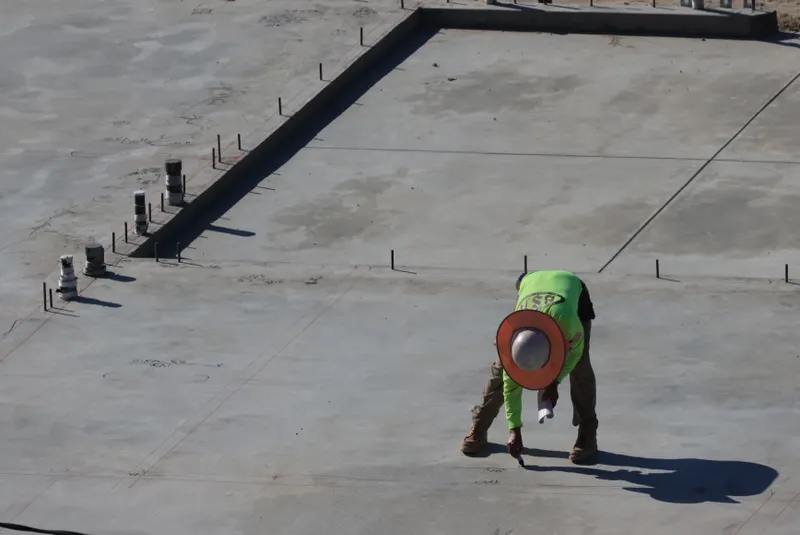
Shed, AC, Hot-Tub & RV Pads
A shed or AC condenser pad is typically 4 inches of 3,000 psi concrete over compacted base — enough for the load, priced efficiently for a small footprint. A hot-tub pad needs more: reinforcement rated for a loaded spa's weight, often 2,000 to 5,000 pounds full of water and people, sized to spec rather than poured to a generic shed thickness.
RV and equipment pads scale up again, usually poured thicker with heavier wire mesh or rebar to handle a vehicle's point loads without cracking under the tires.
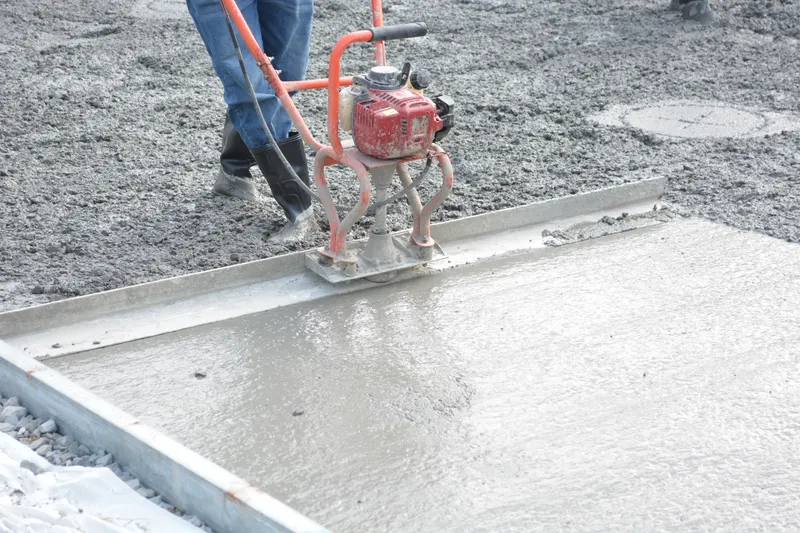
Garage & Shop Building Slabs
Garage and shop slabs typically run 4 to 6 inches of 3,500 to 4,000 psi concrete with a vapor barrier underneath to keep ground moisture from wicking up through the floor — critical under a garage that's finished or used for storage. Reinforcement is rebar or welded wire mesh set on chairs at the correct depth, not laid on the ground and hoping the pour lifts it into place.
We finish these slabs level and broom-textured for grip, with control joints cut in a grid sized to the slab's dimensions.

Subgrade Prep, Rebar & Vapor Barrier
Every slab we pour starts with the subgrade, not the concrete — excavate to grade, compact in lifts, and place a gravel or crushed-stone base before a single form goes down. On expansive clay, skipping compaction is the single biggest reason a slab settles unevenly within a year or two.
Rebar or wire mesh goes in next, tied at the correct spacing, with a vapor barrier laid beneath any slab that will carry finished space above — that combination is what actually resists the seasonal clay movement underneath it, not the concrete mix alone.
The Benefits
Why Proper Slab Engineering Matters in Fort Worth
A slab that's under-built doesn't fail on day one — it fails in year two or three, once the clay underneath has cycled through its first full wet-dry season.

Built for Haltom City's Aging Housing Stock
Haltom City grew from 42,409 residents in 2010 to 46,073 by 2020, and its 1950s-70s residential core, along with the Belknap and Beach Street commercial corridor, means a steady mix of homeowners adding a shed or shop pad next to a decades-old house and property managers pouring equipment pads for light-industrial tenants. Both need the same honest base prep regardless of how old the house next to the new slab is.

PSI Mix Matched to the Load
We spec 3,000 psi for standard shed and patio-adjacent pads, stepping up to 3,500 or 4,000 psi air-entrained mix for garage slabs, shop floors, and anything carrying a vehicle. Air entrainment matters here specifically — the microscopic air bubbles relieve pressure from the occasional winter freeze, which keeps a slab from spalling the way an under-specified mix does after a few freeze-thaw cycles.

Control Joints Cut Before the Concrete Cracks Itself
Every slab shrinks slightly as it cures, and control joints — tooled or saw-cut within 6 to 18 hours of the pour — give that shrinkage a straight line to crack along instead of a random crack through the middle of the pad. Joint spacing is planned before the pour based on slab thickness and dimensions, not added as an afterthought once the concrete's already curing.
Why Us
Why Fort Worth Chooses Us for Slabs & Foundations
Fifteen years of pouring pads on reactive clay means we don't guess at reinforcement — we spec it.
Crews Certified to ACI Flatwork Standards
The crews we coordinate with hold ACI Concrete Flatwork Finisher and Field Testing Technician certifications, are fully licensed and insured, and follow ACI 302 guidance on slab construction and jointing — the difference between a pad that stays flat for decades and one that needs mudjacking within a few years of the pour.
We Know Which Blocks Move the Most
Haltom City's older core, Watauga's dense 1970s-90s subdivisions, and North Richland Hills' newer build-out all sit on the same reactive black gumbo clay but move on different timelines depending on age and drainage — knowing which corridors settle fastest means a more accurate reinforcement spec before a crew shows up with rebar.
Written Quotes, No Mid-Job Upcharges for Reinforcement
We spec the rebar, mesh, or fiber and the exact psi mix at the quote stage, in writing, so a homeowner never gets a call mid-pour asking for more money to reinforce a slab that should have been specced correctly the first time.
A slab is the foundation for whatever sits on top of it, so if yours has already started cracking or settling instead of you starting fresh, our concrete repair page covers leveling and resurfacing before you consider a full tear-out. The same North Fort Worth concrete crew that engineers shed and shop pads across Haltom City, North Richland Hills, and Watauga also handles the full services lineup — call (817) 710-2599 and we'll spec the right thickness and reinforcement for what you're actually building.
Frequently Asked Questions
How much does a concrete slab or foundation pad cost in Fort Worth?
A standard concrete slab or foundation pad runs $5 to $12 per square foot in the North Fort Worth area, with the low end covering a simple 4-inch shed or AC pad and the higher end covering thicker, heavier-reinforced garage and shop slabs. A typical 10-by-12 shed pad lands well under $1,000, while a two-car garage slab at 400 to 600 square feet runs several thousand once base prep, rebar, and finishing are included. Price moves with thickness, reinforcement type, and whether the subgrade needs extra compaction or a vapor barrier. We quote in writing before scheduling, so the number doesn't change once the forms are set.
How thick should a shed, garage, or shop slab be?
A shed or AC pad typically runs about 4 inches of 3,000 psi concrete, which is enough for light equipment loads on a small footprint. A garage or shop slab needs more, usually 4 to 6 inches of 3,500 to 4,000 psi air-entrained concrete, thicker still if it's carrying a vehicle lift or heavy shop equipment. RV pads and equipment pads for larger machinery often step up to 6 inches or more with heavier wire mesh or rebar sized to the point loads involved. We spec thickness based on what's actually going on the slab, not a single default poured everywhere.
Do I need rebar, wire mesh, or fiber reinforcement in my slab?
Most residential slabs get either rebar or welded wire mesh, tied and set on chairs at the correct depth so it sits in the middle of the pour rather than resting on the ground. Fiber reinforcement is often added on top of mesh or rebar for extra crack resistance, especially on slabs with a lot of surface area like a shop floor. Which combination we use depends on the slab's thickness, its span, and the load it carries — a shed pad needs less than a garage slab built to hold a vehicle lift. Skipping reinforcement entirely on anything but the smallest pad is how a slab ends up cracking and settling unevenly on North Texas clay.
What's a vapor barrier, and does my slab need one?
A vapor barrier is a layer of poly sheeting placed under the gravel base and slab to stop ground moisture from wicking up through the concrete once it's poured. It matters most under garage slabs, shop floors, and any pad that will carry finished living or storage space above, since trapped moisture can damage flooring, stored goods, or equipment set directly on the slab. Outdoor pads like sheds, AC condensers, and open patios generally don't need one, since moisture simply evaporates off an exposed surface. We spec a vapor barrier based on what the slab will be used for, not as a blanket upcharge on every job.
How long before I can walk, drive, or build on a new slab?
New concrete slabs are safe for foot traffic in about 24 to 48 hours and can handle vehicle traffic or parking at roughly the 7-day mark, though full design strength — the 3,000 to 4,000 psi the mix is specified for — isn't reached until 28 days. If you're building a shed or structure on top of the pad, we recommend waiting for that full 28-day cure before framing begins, since the slab is still gaining strength through the first month. Cold weather below about 50 degrees slows every one of these timelines down, which we factor into scheduling on winter pours.
Can you pour a new slab over an existing one, or does it need to come out first?
It depends on the existing slab's condition — if it's structurally sound with no major cracking or settlement, a new pour or overlay can sometimes go on top, though this is more common on decorative work than on structural pads. If the existing slab has cracked, heaved, or settled from clay movement underneath it, pouring over it just repeats the same problem at a higher elevation, so we recommend removal and a proper subgrade rebuild instead. Our [concrete repair](/concrete-repair) page covers crack and leveling assessment if you're not sure which category your existing slab falls into. We inspect before quoting either approach rather than defaulting to whichever is faster.
How does control joint spacing work on a slab or foundation pad?
Control joints are tooled or saw-cut into the surface within about 6 to 18 hours of the pour, spaced based on the slab's thickness and dimensions so shrinkage cracking follows a straight, planned line instead of cracking randomly through the middle of the pad. A typical 4-inch slab gets joints spaced roughly 10 to 12 feet apart, tighter on thinner or more exposed pours. Skipping joints, or cutting them too late after the concrete has already started shrinking, is one of the most common reasons a slab develops an unplanned crack in its first year. We plan joint layout before the pour, not as an afterthought once the concrete is curing.
Why does North Texas clay matter so much for slab and foundation work?
Haltom City, North Richland Hills, and Watauga all sit on high-plasticity black gumbo clay that swells when wet and shrinks hard through the long dry summer, moving several inches seasonally underneath anything poured on top of it. A slab poured without proper subgrade compaction, base material, and reinforcement will telegraph that movement as heaving, cracking, or an uneven corner within a year or two, especially on an isolated pad like a shed or hot-tub slab that lacks a house foundation's depth to anchor it. Proper compaction, a gravel base, and correctly sized reinforcement are what actually resist that movement, not a thicker pour alone.
What's the difference between a slab, a footing, and a foundation wall?
A slab is a flat, poured pad sitting at or near grade — a shed pad, garage floor, or patio are all slabs. A footing is a wider, often deeper concrete base poured below the frost or movement zone that spreads a structure's load into stable soil, commonly used under foundation walls, posts, or heavier structures. A foundation wall is a poured or block vertical wall built on a footing to support a structure above grade, common under additions rather than a simple slab-on-grade shed or garage pad. Most residential accessory pads — sheds, AC units, hot tubs — only need a properly reinforced slab, not footings or walls, unless the structure above is unusually heavy.
Do I need a permit to pour a shed, garage, or shop slab in Haltom City, North Richland Hills, or Watauga?
Each of the three cities runs its own building and permitting department rather than routing through Tarrant County, and slab work tied to a permanent structure — a garage, shop, or attached addition — typically requires a permit in all three. Smaller accessory pads like a shed base, AC pad, or hot-tub slab sometimes fall under a lower threshold depending on square footage and whether a structure is being built on top, so requirements vary by address and by what's going on the pad. We confirm what applies to your specific project and city before pouring, so a slab never turns into a compliance problem after the fact.

Get a Free Quote on Your Slab or Foundation Pour
Shed, garage, hot-tub and shop pads, engineered for Fort Worth clay. Call (817) 710-2599.
Call (817) 710-2599